



Isabella Proto
Consultant
I enjoy working with a focus on people and processes to break out of existing routines and create lasting value.
Many organizations are grappling with the same fundamental question: Why aren’t our sustainability goals moving forward, even though the will to do so is there?
An ESG Quick Scan allows you to determine the extent to which sustainability has been integrated into your organization’s strategy, management, and accountability. This helps identify the biggest challenges in translating strategy into visible daily behavior and measurable impact. This article explains what an ESG Quickscan is, the different types available, and why it’s valuable for developing a plan of action.
Table of contents
Many organizations have plenty of ambition when it comes to sustainability; however, the problem often lies in communicating and implementing it: departments have different priorities when organizing governance, processes are not designed with sustainability in mind, or KPIs do not align with the ESG strategy or CSRD requirements. As a result, organizations are not sufficiently able to translate sustainability into a coherent and actionable process, leaving much potential for impact untapped.
This situation stems from the gap between intention and action — the so-called “intention-realization gap.” The actual obstacle is usually not a lack of ambition, but a lack of focus, ownership, and a shared understanding of where the organization currently stands. As a result, progress stalls, next steps remain unclear, and sustainability efforts feel fragmented. This makes it difficult to determine what the next step really should be.
On top of that, external pressure is mounting rapidly. Customers expect reliable ESG data, supply chain partners demand transparency, and laws and regulations are being introduced at a rapid pace.
To bridge the gap between ambition and implementation, insight is needed first. The ESG Quick Scan addresses this need. It provides insight and focus through a concise baseline assessment. This makes it clear where the greatest opportunities for acceleration lie, both organization-wide and by department.
Organizations choose the ESG Quickscan because it:
The ESG Quick Scan is based on Prof. Rob Van Tulder’s transition theory. His theory emphasizes that companies do not develop in a linear fashion, but rather follow different “transition paths” depending on their motivations, capabilities, and partnerships. The ESG Quick Scan translates this theory into a practical baseline assessment across two dimensions:
The matrix below illustrates where an organization stands based on the relationship between its intention to become more sustainable (motivation) and its actual implementation (realization).
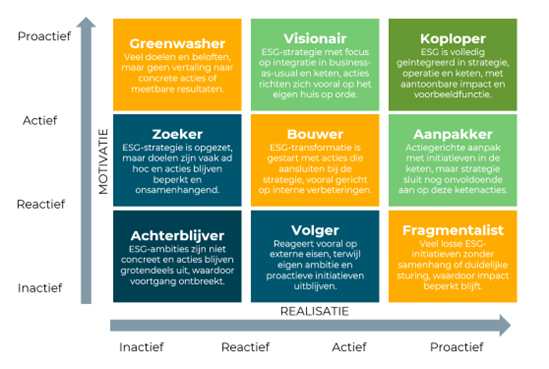
By plotting companies on this matrix, you immediately gain insight into:
Understanding the points above helps in determining a strategic starting point for sustainability initiatives. The 9-Role Model provides insight into where an organization stands in its sustainability development by highlighting blind spots, tensions, and opportunities for growth. In this way, the ESG Quick Scan bridges the gap between ambition and implementation: a tool that guides the sustainable transition and long-term value creation.
The ESG Quickscan is available in five versions, each designed to address a common organizational challenge.
Would you like to learn more or discuss the best approach for your organization? Feel free to contact our expert.
Isabella Proto