



Floor van Oers
Consultant
I get a boost of energy from finding practical solutions to complex sustainability issues.
Climate change has a direct impact on operations, costs, and strategic decisions. Extreme weather conditions, changing legislation, and new market developments create financial risks that can no longer be ignored.
It requires adaptation. But many companies are grappling with the same fundamental questions. How do you make these risks tangible? How do you determine what impact they could actually have on your business? In this article, you’ll learn how to make climate risks transparent and financially substantiated, so you can make better decisions and comply with the latest reporting requirements.
Table of contents
At 2BHonest, we help organizations take exactly that step: making the financial impact of climate change visible. This creates a common language between finance, sustainability, and management — the only way to steer a course effectively in a world where changes are occurring at an ever-faster pace.
We see that organizations face three structural problems:
Quantifying climate risks in financial terms helps organizations prioritize more effectively, support strategic decisions, and make targeted investments in measures that protect value. This provides financial insight into the potential impact a climate risk could have on the business. This involves calculating the specific financial impact, such as damage, loss of revenue, cost increases, or asset impairments.
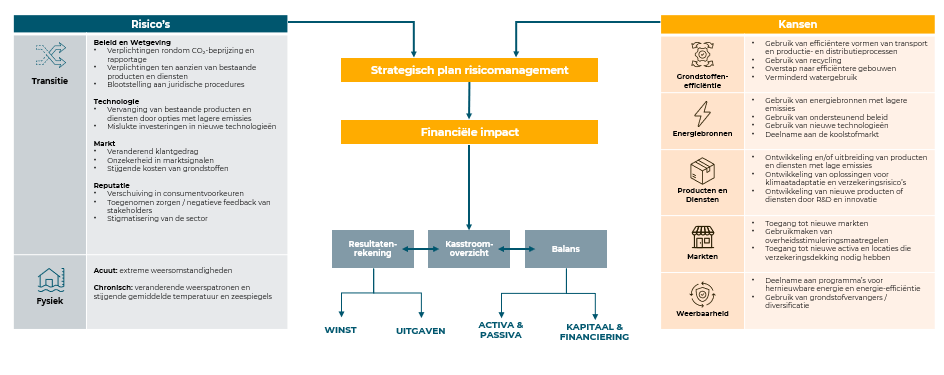
By taking a targeted look at where the company operates, which activities are critical, and which processes are vulnerable to physical or transition risks, a clear picture of the most relevant risks emerges.
Customer Case Study: As a food company, Baker & Baker faces the greatest pressure from extreme weather conditions affecting product quality and production capacity. In addition, there are rising requirements and costs throughout the supply chain due to climate legislation and raw material shortages. By focusing on these issues, the climate risk analysis could be applied in a targeted manner.
For each risk, determine which data and financial methods are most suitable for quantifying its impact. We then identify which internal and external data are needed for this purpose. Internal data — such as asset values, volumes, and operational information — are linked to external climate scenarios, market expectations, and technological assumptions.
Once the financial impact has been assessed, we develop investment and policy scenarios that provide insight into the consequences of different choices. They illustrate the implications of investing or not investing, which measures protect value, and how risks affect margins, cash flows, and asset valuations. Executives use these scenarios to determine strategic direction and set priorities.
Client Case Study: At Signature Foods, we identified CO2 reduction measures and calculated the associated investments. We classified these into three categories. This allowed us to establish priorities and provide targeted support for decision-making.
We then help clients design a governance structure that ensures climate risk assessment does not remain a one-time analysis. Departments such as Finance, Sustainability, Operations, Procurement, and IT collaborate systematically on this, with clearly defined roles and data flows. This makes the assessment reproducible, consistent, and fully aligned with internal controls and CSRD requirements.
Finally, clients work with us to establish a process for ongoing monitoring and reporting. This adaptive approach ensures that scenarios remain relevant, decisions are recalibrated as needed, and the organization remains structurally prepared for new uncertainties.
By assessing the financial impact of climate risks, a clear, comparable, and decision-oriented risk profile emerges. Organizations can prioritize measures, substantiate investment decisions, and refine strategic choices leading up to 2030 and beyond. The result is an approach that not only complies with regulations but, above all, protects and creates value. In this way, climate risks become not only transparent but, above all, manageable.
Want to learn more about the financial impacts of climate risks in your industry? Get in touch, and we’ll be happy to help you figure it out.


Floor van Oers Consultant
Hidde Kraaijveld Consultant
Floor van Oers

Hidde Kraaijveld