


Floor van Oers
Consultant
I get a boost of energy from finding practical solutions to complex sustainability issues.
Sustainability managers and organizations are increasingly encountering terms such as PCF, LCA, EPD, and DPP. It’s easy to confuse them, since they all mean slightly different things. How do they relate to one another? And more importantly: when should you choose which approach?
In this deep dive, we’ll explore the differences, connections, and strategic choices surrounding these four methods. This will ensure that you, as a professional, are prepared for the demands of today and tomorrow.
Table of contents
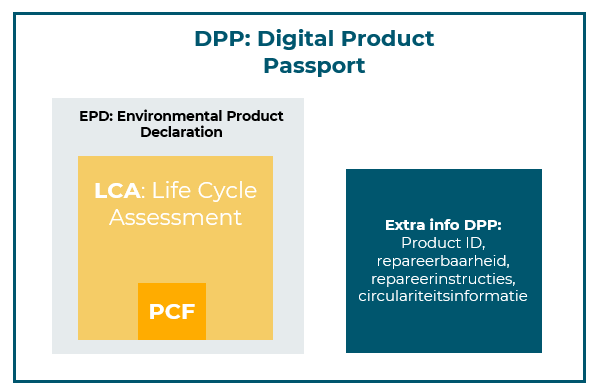
Life Cycle Assessment (LCA) is the standard for determining a product’s environmental impact. An LCA examines the entire life cycle: from raw material extraction, production, transportation, and use through to waste disposal or recycling. This typically involves analyzing 19 different impact categories, including climate change, water use, eutrophication, ozone impact, land use, and toxicity. An LCA is very specific to a particular product with a specific value chain. A drawback of LCAs is that this makes comparability a challenge (don’t worry: later in this article, we’ll explain the solution to this).
An LCA is therefore the tool of choice for organizations that want to understand, optimize, and substantiate the full range of environmental impacts. It also serves as the foundation for many other tools and reports.
Product Carbon Footprint (PCF) is derived from the LCA, but with a clear focus: it tracks only greenhouse gas emissions (expressed in CO₂ equivalents). This aligns with the growing concern about climate change and the need for quick, clear climate claims.
PCF is ideal for organizations that want to gain insight into their climate impact quickly (or more quickly), for example, to support climate claims or comply with CO₂-related regulations. In practice, we often find that a PCF is more accessible and applicable for an organization than an LCA. It is also easier to conduct multiple PCFs, for example, to compare two alternatives for a product.
An Environmental Product Declaration (EPD) is not a calculation method, but a standardized communication tool based on an LCA. An EPD makes it possible to communicate the environmental impact of products in a transparent and comparable way, for example to customers, clients, or in tenders. Whereas an LCA has different assumptions and system boundaries, all EPDs share the same ones. It is a way to express an LCA, to present it in a specific format.
EPDs are particularly relevant in sectors where transparency and comparability are essential, such as the construction industry. In many European countries, an EPD is even required for building materials, and it is used as standard in sustainability certification systems such as BREEAM and LEED.
The Digital Product Passport (DPP) is a relatively new concept, but it will have a huge impact in the coming years on the way product data is collected, shared, and used. A DPP is not an impact assessment, but rather a digital identity card for products that records data from an LCA, PCF, and/or EPD, supplemented with additional information such as product IDs, manuals, repair instructions, and circularity information. DPPs are a direct result of the European Green Deal and the Ecodesign for Sustainable Products Regulation (ESPR).
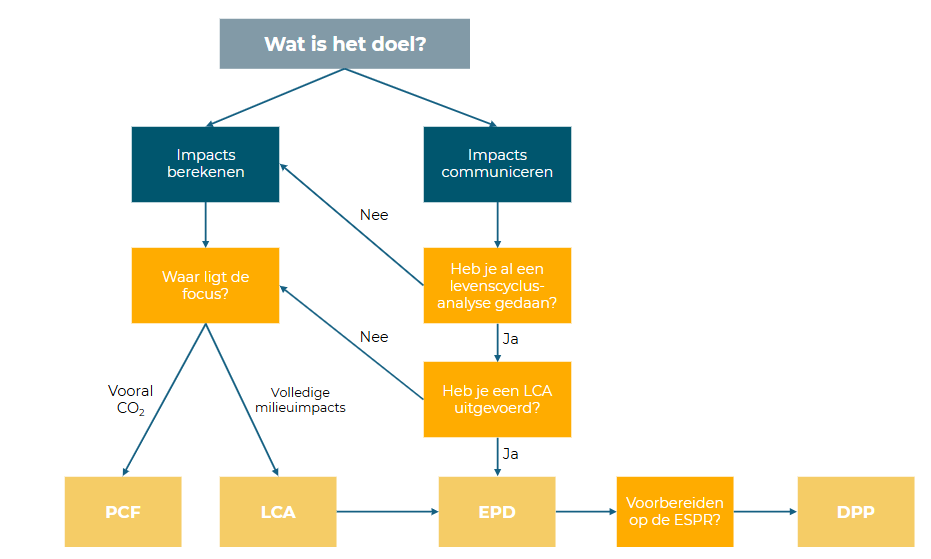
The choice between PCF, LCA, EPD, or DPP depends on the objective, the maturity of the organization, the sector, and the available budget and time. Please note: each step builds on the previous one. A DPP without an underlying LCA or EPD is incomplete. The time investment increases from PCF (low) to DPP (high). Use the decision tree below to get an idea of which approach best suits you and your organization.
PCF, LCA, EPD, and DPP are indispensable tools for organizations that are serious about sustainability, transparency, and compliance. They are closely interrelated, but each has its own role and scope of application. By strategically choosing and investing in the right approach, your organization will be ready to meet the demands of both today and tomorrow.
Would you like to learn more or discuss the best approach for your organization? Feel free to contact our expert.
Floor van Oers