


Jannah Sonneschein
Driven to accelerate sustainable solutions. Strong in analysis, skilled in complex calculations, and always focused on clear insights.
Water is often affordable and seems to be available in unlimited quantities. But imagine this: the tap stays shut. Or your production comes to a halt because of contaminated water. Or extreme drought — or, conversely, a flood — disrupts your supply chain. What then? Water security and water safety are less a given than we think. How can companies prepare for the risks lurking behind our dependence on water? We’ll discuss this with consultants Jannah and Beau. Because, as they say: “We still too often take water for granted — something we can always count on. But is that really justified anymore?”
Water issues take many forms. Sometimes there is too much water, sometimes too little, and sometimes the water that is available is simply unusable. This combination makes the issue both complex and urgent. And it is no longer just a problem that doesn’t concern us.
Broadly speaking, we distinguish four types of water problems that exist worldwide:
1. Excessive water due to extreme weather
Floods and extreme rainfall are causing damage worldwide. In 2022, one-third of Pakistan was flooded, forcing millions of people to flee; the water crisis has gripped the country ever since. In Germany and Belgium, extreme downpours in 2021 led to devastating floods in the Eifel region. Parts of Italy, India, and South Africa have also recently experienced exceptional flooding — to name just a few examples.
2. Insufficient water due to drought
Simply put: there isn’t enough. Climate change and overexploitation are causing water sources to dry up. In Cape Town,“Day Zero”was announced as early as 2018: the day when, literally, no more water would come out of the tap. In Spain and Italy, prolonged droughts are on the rise, with major consequences for agriculture and nature.
3. Insufficient usable water
Not all water is suitable for use. Freshwater — which accounts for only a fraction of all the water on Earth — often needs to be purified or pumped up. Pollution from agriculture, industry, or households is making this increasingly difficult. Wastewater is still too often discharged without considering the consequences for people and nature. In the Netherlands, too, the quality and availability of drinking water are under pressure.
4. Political and economic tensions
Water is increasingly becoming a source of conflict. Consider dam projects in river basins such as the Nile or the Mekong, where downstream countries are dependent on political decisions made elsewhere. And as water becomes scarcer, its value rises. In some cities, water quotas to ease the pressure on the system are already a reality. In parts of the world, water has now become just as strategic as oil or gas — resulting in price increases, speculation, and power politics. Globally, water is increasingly viewed as“a source of peace and conflict.”
Various. Earlier this year, the NOS ran a headline stating that without measures, shortages are likely to occur in parts of the country starting in 2030. In the province of Utrecht, for example, action plans are already being drawn up to find new sources. Because, as the drinking water company Vitens states very clearly in this article: “The situation is becoming critical. Especially in the summer, there’s barely enough water.”
Flood protection also remains an issue that requires constant attention. The Netherlands is known for its strong water management, but our location below sea level makes us structurally vulnerable. The floods in Limburg in 2021 were a clear wake-up call.
Water issues affect businesses on multiple fronts — within your own operations, throughout your supply chain, and at the strategic level. When it comes to your own business operations, the rule is simple: without water, there is no production, no cooling, and no hygiene — that goes without saying. And in some regions, companies are already facing water quotas or restrictions on usage.
Problems can also arise within your value chain. For example, if suppliers are affected by drought, flooding, or water contamination, resulting in delays, higher costs, limited availability, or even a complete halt in operations.
And finally: water is becoming an increasingly prominent issue on the sustainability agenda. Sustainability assessments, regulations, and social pressure make it clear that responsible water management is no longer an optional choice. Soon, it will be impossible to ignore.
It comes down mainly to clear goals. For CO₂, it’s clear: net zero by 2050. It’s been on the agenda for years, backed by clear international agreements. Legislation, policies, and reporting are built around it. That provides both direction and pressure. For water, there are standards and environmental regulations, certainly in Europe. But a concrete goal? A measurable ambition? That’s missing.“Water security for all” sounds nice, but what does it mean exactly? As long as water goals aren’t measurable and there are no tangible frameworks, action often fails to materialize. This is further compounded by the fact that in many wealthy countries, water is taken for granted. The faucet works, the shelves are full, and drought or flooding seems like an occasional occurrence. The urgency of the problem is not yet widely felt.
But although water receives even less attention than CO₂, there are a striking number of similarities between the two.
Yes, they function in the same way, for example. Water flows, evaporates, becomes polluted, and crosses borders — just like CO₂. What is used or discharged here can have consequences hundreds of kilometers away. Another similarity is that the supply chain plays a major role. If your products are manufactured in China, India, or South Africa, you’re indirectly using water from areas that are often vulnerable. Our consumption here has an impact there.
Water, like CO₂, is complex, boundless, and elusive. But the approach to CO₂ shows that we can indeed get a handle on something that is widespread globally and seems difficult to grasp. That requires insight, cooperation, and strategy — exactly what we need now for water as well.
That’s right. Climate, nature, and water are not separate issues, but closely interconnected systems. CO₂ emissions contribute to global warming, which leads to more extreme precipitation and longer periods of drought. This affects the availability and quality of water.
At the same time, the degradation of natural areas also affects water. Deforestation disrupts the water cycle, and water shortages weaken soils and vegetation, causing ecosystems to deteriorate. This, in turn, leads to even more deforestation.
A future-proof sustainability strategy therefore doesn’t just look at CO₂ or biodiversity in isolation, but at the interconnections between all natural systems. Incorporating water as a pillar helps prevent tunnel vision — and increases your company’s resilience.
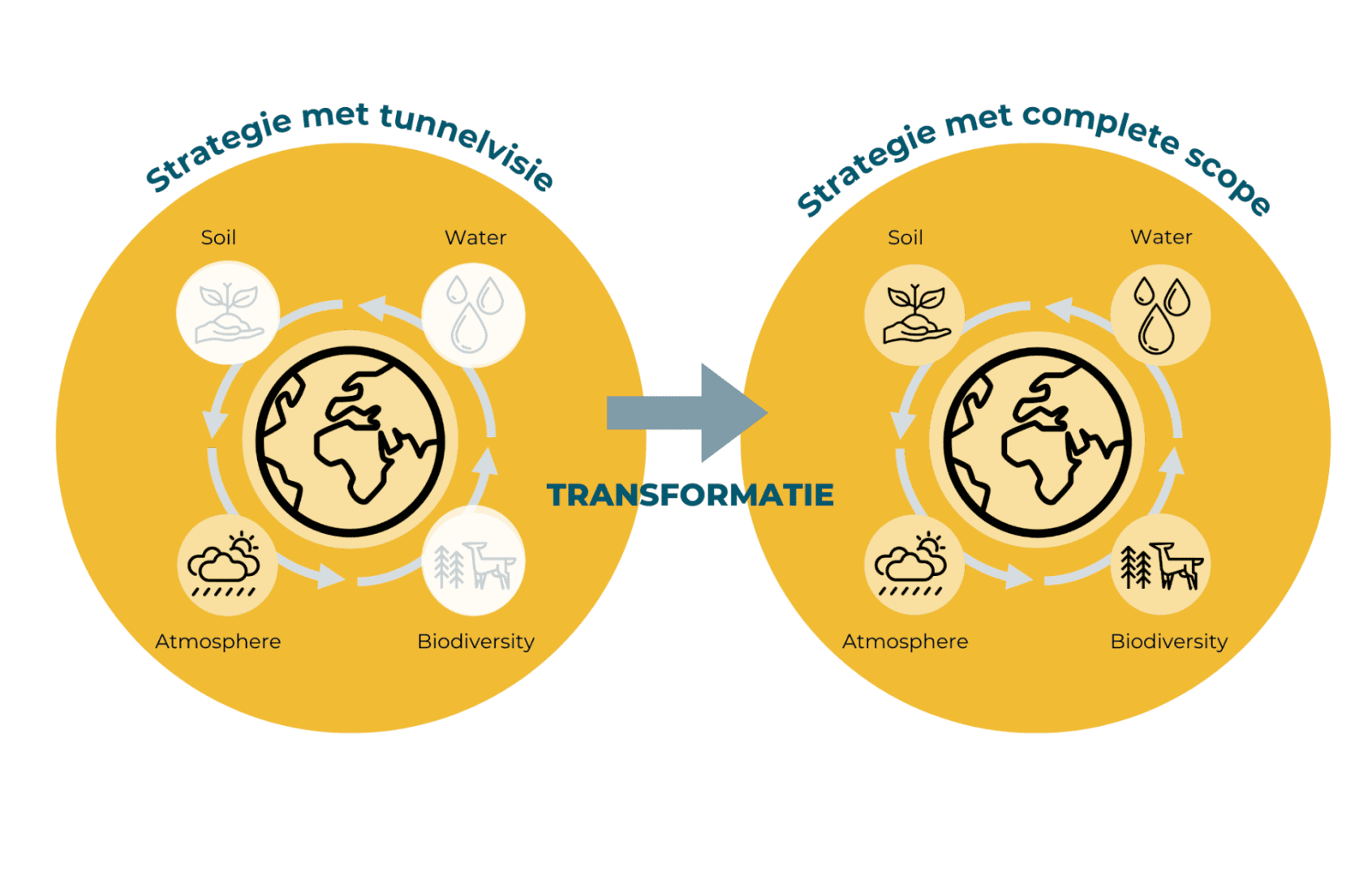
You incorporate water into your ESG policy at various levels. At the strategic level, you define how your organization addresses it — just as you do with CO₂ and biodiversity. Then it’s all about going deeper: measuring, analyzing, and improving. Because only with insight can you truly make an impact — for example, through reduced consumption, better water quality, and more efficient processes.
To assess your situation, start with some simple questions: Do our processes use a lot of water? Do we operate in high-risk areas? Are we vulnerable if the water supply is interrupted? If you answer “yes” to any of these — and the chances are high that you will — then water is a critical resource for your business. It’s time to get serious about developing a strategy.
We use a practical three-step model to help companies move from awareness to action.
1. Make water a topic of discussion
Don’t let the complexity deter you; instead, make sure water becomes a regular part of your strategic agenda. Raise internal awareness of the risks, the urgency, and the opportunities.
2. Define your impact and risks
Identify where your company depends on water — both internally and throughout the supply chain. Where does your water come from? How much do you use? Do you pollute it? In which areas do you operate? Perhaps you — or your suppliers — work in regions where water stress wasn’t previously an issue, but now it is. This can have major consequences for business continuity, permits, and reputation. With our water footprint calculator, we help companies gain insight into their water consumption and (hidden) dependencies, both direct and indirect. This allows you to mitigate risks in a much more targeted way (see Step 3).
3. Develop a strategy and action plans
Outline how you can reduce your water consumption, prevent pollution, and diversify your sources of supply. For example, by implementing more efficient processes, investing in water treatment or reuse, collaborating with suppliers to reduce supply chain risks and minimize your collective impact, and exploring alternative water sources or production locations. Just as with raw material scarcity, the rule is: don’t put all your eggs in one basket — whether that’s a single location, source, or supplier. Judith already discussed this in this blog post. By diversifying risks and increasing sustainability, you enhance your company’s resilience.
Water is like oxygen — it’s only when it’s gone that you realize how important it is. Water may seem cheap (for now), but its true value is immense. Ask yourself: what if it were no longer available? What would that mean for you, your business, and your supply chain? Water must remain accessible to everyone, and that means we can’t take it for granted. Don’t let the complexity of water be a reason to ignore it; instead, see it as a reason to take action.
Companies that gain insight into their water dependence now will be better prepared for future water shortages, stricter regulations, and rising costs. We’re here to help — from footprint assessment to strategy.
Let’s keep our heads above water together? 😉 Jannah and Beau are ready!
Jannah Sonneschein

Beau Munnik