


Maarten Andriessen
Senior Consultant
Many companies are focused on CO₂. And rightly so: reducing emissions is crucial — that’s how we influence the climate. But the climate also influences us. And that calls for something else: adaptation. Because the consequences of a changing climate affect companies in many ways. A raw material that suddenly becomes more expensive. A delayed shipment. Customers who walk away because their values are changing. An empty shelf. These aren’t coincidences, but the hidden effects of climate change. Gradual, hard to grasp, and sometimes invisible — but with major long-term consequences. “You don’t have to be underwater yourself to be affected,” explains Maarten Andriessen. “The impact might be right on your doorstep, but much more often it creeps in through a roundabout route — via your supply chain, your costs, or your revenue.” In short: it’s time to assess climate risks.
When it comes to climate, the focus is often on minimizing your own impact: reducing, offsetting, and adopting a circular approach. That falls under climate mitigation: how does your organization affect the climate? In other words, inside-out. That’s important, but it’s only half the story. The other half is about climate adaptation: how the climate affects you — in other words, an “outside-in” approach. What do you do when circumstances change? Are you prepared for extreme weather events like droughts or floods? For new legislation or changing consumer behavior? And how resilient are you? Becoming more sustainable is therefore not just a matter of emitting less, but also of ensuring that your business model adapts to a changing climate.
We hear that a lot. Especially in the Netherlands, where we seem to be relatively safe. No hurricanes like in Florida, no wildfires like in Southern Europe. But if you look at the weather itself — heat waves, droughts, floods, storms — you’ll see that these kinds of extremes are rapidly increasing in intensity and frequency worldwide, and here too, the boundary is shifting further and further. This increase makes the physical risks posed by these types of weather conditions increasingly relevant: sometimes acute, such as damage caused by a downpour or storm; often chronic — consequences of gradual changes that are here to stay, such as persistent drought or a structurally warmer climate.
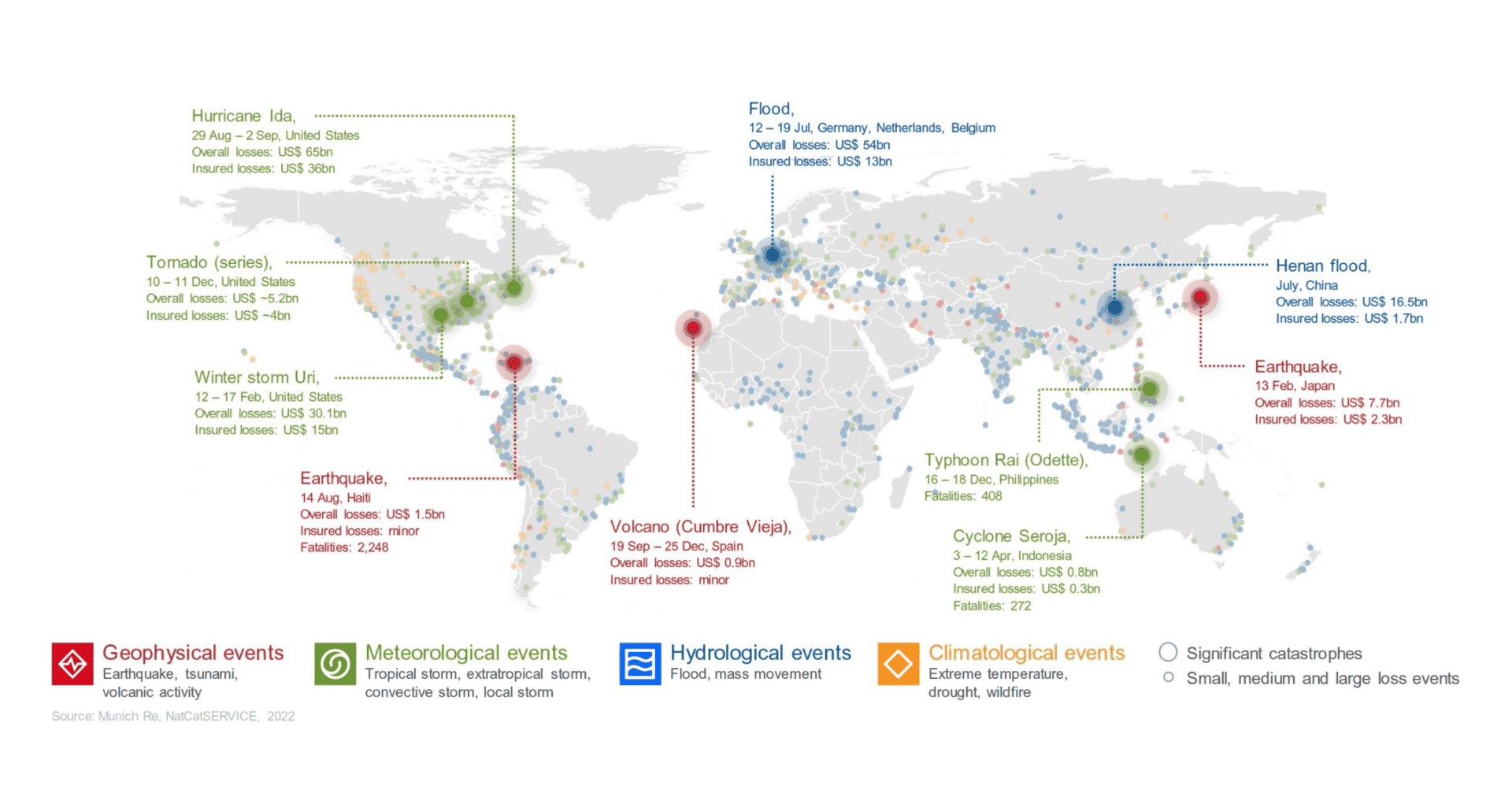
Economic losses caused by extreme weather events have been rising worldwide for decades. It is therefore important for companies to look beyond their own premises or ZIP code. Not just: What’s happening around me? But also: How dependent am I on places where risks are increasing? Suppose your bakery sources its grain from southern Germany. Then you’ll want to know: How do weather conditions there affect the harvest? And how will that develop in the coming years? This is how you identify the impact of physical risks on your supply chain — and how you can take timely action if necessary.
No. And that is precisely the misunderstanding. In the event of a disaster, such as the one in Limburg in 2021, the focus is often on direct “insurable” damage — flooded homes, cars, and commercial buildings. But the biggest economic blow often comes afterward: when businesses grind to a halt, transportation comes to a standstill, deliveries fail, or entire supply chains grind to a halt. That damage is often much greater than the direct damage, as shown in the image below.
And it doesn’t even have to be nearby. A flood in China can affect a clothing brand in Europe. A failed sugarcane harvest in India or Thailand can lead to higher prices on store shelves here. You don’t have to see “your own factory underwater” to be affected. If your supplier is affected, or if transportation to them comes to a standstill, you might also run out of materials to produce or deliver. A one-week delay might be manageable for one company, but disastrous for another.
I often compare it to the container ship that got stuck in the Suez Canal. That wasn’t a climate-related event, but it perfectly illustrates just how vulnerable supply chains are: one blockage, and thousands of companies can’t deliver their goods. The blockage held up more than 8 billion euros in trade every day. With climate risks, it actually works exactly the same way.
That’s right. Because in addition to the weather, the world around us is also changing in response to climate change. Governments are implementing climate policies, and technology is advancing at a rapid pace. These developments bring their own risks: transition risks.
Consider stricter environmental requirements in the construction industry, which could suddenly make certain materials or methods unusable and force you to rethink your approach or even your entire business model. Or think of cities with zero-emission zones — if you only have diesel vans, you won’t be able to enter them anymore.
Changing customer preferences also require us to adapt. Because what if your offerings no longer meet their needs? Then you’ll lose both relevance and revenue. Take electrification, for example — more and more manufacturers are making that shift. Those who cling to the internal combustion engine will be overtaken by competitors who are going electric. The same goes for the growing preference for organic or plant-based products. Those who fail to adapt will lose their relevance to customers — and to the future.
And then there’s your reputation. Companies that are perceived as polluting or lacking transparency are more likely to face criticism and sometimes even legal action. Civil society organizations such as Milieudefensie are increasingly scrutinizing companies and challenging them to adopt stricter climate policies. Greenwashing can also cost you dearly: a false claim can damage your credibility and cost you customers.
Absolutely. What may seem like a risk can also be an opportunity — as long as you adapt in time. Up front, that means keeping pace with the market. Think of new, cleaner products or services that align with changing customer needs. Or partnerships with startups that are capitalizing on sustainability trends.
Behind the scenes, it’s all about your resilience: ensuring you can always deliver what you promise. That requires a future-proof supply chain and a robust revenue model. You need to be less dependent on a single supplier, location, raw material, or customer. Because if something goes wrong there, you’ll come to a standstill. Can you source your raw materials from multiple locations, or even replace them with other ingredients or materials? If so, you can keep operations running, even if things go awry somewhere.
Of course, you don’t need to have a backup plan for everything, but you do need to know where your vulnerabilities lie. That awareness helps you spread risks in a targeted way. That’s how your company becomes resilient, robust, and agile.
It starts with insight. Many organizations haven’t assessed the financial consequences of, for example, a crop failure in southern Germany or a flood at a supplier’s facility in China. Yet these aren’t hypothetical scenarios — they’re already happening. It’s just that the connection often isn’t made. Until you start digging into it together… then we often hear, “Oh yeah, we had that last year, too…” And that’s when it hits: it’s all interconnected.
Without that insight, you may have been quietly losing market share, revenue, or opportunities for years without even realizing it. For example, because you’ve simply accepted rising material costs, or because your offerings no longer align with changing expectations. Only when you actively address these issues will you begin to see where the risks lie — and where you’ve already been affected — without having recognized it as such.
A climate risk analysis helps identify these types of vulnerabilities. Which processes come to a standstill during disruptions? How long can you go without certain raw materials or transportation? And what does that mean for your customers, your deliveries, and your revenue? Once you know that, you can take much more targeted measures and avoid unpleasant surprises.
Many companies are willing to take action but don’t know where to start. We help organizations assess their climate risks. This begins with clearly defining the scope: what is relevant to your company, your supply chain, and your product? Next, we work with you to assess the magnitude of both physical and transition risks and, where possible, provide quantitative insights. This gives you clarity on what’s truly urgent. And it helps you determine whether you can respond to disruptions in your supply chain, your market, or your production.
But that’s not the end of it. Ultimately, you also want to know: what are we going to do about it? That’s why we translate these insights into an action plan. Which risks do you need to mitigate, and how? It could be something small — like installing an air conditioner in the office to better cope with heat waves. But it could also mean you need to take a fundamentally different look at your supply chain or product. For example, as one of our clients did. Their products rely on natural ingredients and are therefore vulnerable to crop failures or shortages. Instead of waiting to see what happens, they actively sought out alternatives: Could we also make the product using raw material X or Y? As a result, they’re now less dependent on a single supplier or a single climate-sensitive region — and they can continue to deliver, even if things go wrong somewhere. A creative and smart way to increase resilience.
Of course, we don’t come up with these solutions on our own. On the contrary, the best solutions usually come from within — from the people who know your supply chain, processes, and products inside and out. Our role is to facilitate that process, ask the right questions, and provide examples so that companies can develop smart solutions on their own. Because whether it’s food, construction, or transportation, the real expertise is on the other side of the table. It’s always a collaborative effort.
In short: climate risks rarely come “with sirens.” But their impact is real and often already being felt. It’s time to look not only from the inside out, but also the other way around. How does the climate affect your business? Make sure you understand your risks, identify your vulnerabilities, and work toward a business model that is both agile and resilient.
Will you react or anticipate? With Maarten, you choose the latter. 😉
Maarten Andriessen