


Lydia Boonstra
Senior Consultant
I believe that fair and sustainable supply chains are the future.
Many companies focus on CO₂ reduction and climate goals, but supply chain responsibility sometimes gets “buried under other priorities.” Why is this the case, even though it’s an important legal obligation? What happens if you do nothing? And how do you ensure this issue doesn’t get lost among your other obligations? In this article, we join Lydia in exploring the challenges surrounding supply chain responsibility and how to turn ambition into action. “It all starts at the board level,” says Lydia.
Sustainability is high on the agenda. Many companies focus on CO₂ emissions and climate goals. That makes sense, because these are tangible and urgent. But did you know that the CSRD also requires companies to ensure their supply chain responsibilities are in order? Companies must identify the risks present in their supply chains and take action to address them. Yet this often gets overshadowed by other obligations, or we see that companies aren’t quite sure where to start.
The CSRD consists of several “booklets.” One provides an overarching framework with general requirements (ESRS 2). In addition, there are guidelines on specific topics, such as climate goals or social issues. Companies often focus on the topics most relevant to their industry or business, but the general requirements should not be overlooked. It may seem less urgent, but to meet these requirements, a company must identify its impacts, risks, and opportunities. Establishing a due diligence process is essential in this regard.
Due diligence is the process of systematically identifying risks in your supply chain and taking responsibility for what falls within your sphere of influence. This requires an understanding of your impact on the environment, human rights, and working conditions. It goes beyond “living wages” or child labor; consider, for example, biodiversity and water management. We see that the scope of this process can sometimes be daunting: how deep do you need to dig? Where do you start? How do you deal with risks you can’t address immediately? And what if you uncover a “can of worms” — will you be held responsible for that as well?
Yes, but that’s absolutely not necessary. You don’t have to solve everything right away; not everything falls under your responsibility. What matters is that you know where the risks lie in your supply chain, that you take responsibility where you have influence, and that you’re transparent about it. If you’ve set up your due diligence process properly, you can demonstrate where your responsibility begins and ends.
Exactly. Document your approach in a statement that outlines what you’ve already done, what actions are still pending or beyond your control, and what policy documents you’ve drafted. This forms the basis for meeting legal requirements. But that’s not all; it also helps you build trust with stakeholders and other parties. This way, you can avoid critical questions, doubts about integrity and accountability, or even reputational damage or legal complications.

A well-designed due diligence process can make all the difference. One of our clients was once criticized for the goods it imported. Thanks to their thorough due diligence, they were able to clearly articulate where their responsibility began and ended. This enabled them to communicate transparently and protect their reputation. Without such a process, it would have been much more difficult to respond appropriately.
That’s right; the CSRD and the CSDDD complement each other. The CSRD is about transparency and reporting — the “what.” The CSDDD is about implementation — the “how.” It sets out how companies conduct due diligence, analyze risks, and take action. That makes it very concrete. Interestingly, the CSRD was introduced earlier, even though a robust due diligence process actually forms the foundation for meaningful reporting. Many companies are currently focusing on their reporting, while the underlying process is sometimes not yet in order. Starting in 2027, the CSDDD will fill that gap — a logical and much-needed step!
It starts in the boardroom. That’s where awareness and vision-setting begin: How ambitious do we want to be? Are we aiming for minimal compliance, going a step further, or do we want to be a role model in our industry? Who takes responsibility? And, since you can’t address all the risks in the supply chain at once, your company needs to set priorities. So: where do you place the emphasis?
What we often see is that companies start too quickly at the operational level — for example, in procurement. Of course, that’s important, but without a clear framework at the board level, it remains difficult to get started in a focused and effective way. Policies must be developed from the boardroom that identify risks, define processes, and outline the vision.
Start with desk research and begin with your direct suppliers. Ask the right questions of stakeholders, such as supply chain partners, to identify risks and potential solutions. Keep the cultural context in mind. What’s normal in the Netherlands may be different elsewhere. Consider working hours, for example: a 40-hour workweek is common here, but in other countries, a 50-hour workweek may be the norm. Understanding this helps you find realistic and effective solutions. Moreover, it’s about give and take: don’t just ask what a supplier can do for you, but also consider how you can work together to address risks. Reciprocity makes supply chain responsibility valuable and sustainable.
Next, expand this into an open dialogue with more stakeholders. Work together with local unions or your colleagues to address shared challenges.
Document your actions in a plan with specific goals, and monitor your progress annually to ensure you’re on track. Schedule regular reviews, such as during an annual supplier evaluation. Or organize a stakeholder day — as we do with many of our clients — to gather new insights and improve policies.
Stay in constant communication and adjust your approach as needed. Feedback from stakeholders provides valuable insight into risks in your supply chain and helps you improve processes. You can’t solve every problem right away, but you can prioritize and focus on the issues that your company can actually address. If you run into a closed door with a supplier, choose to allocate your resources elsewhere and try again later if necessary — but don’t lose sight of the risk.
From ambition to action — that’s what we do in supply chain responsibility. Our strength lies in combining a strategic perspective at the board level with practical implementation. We help companies not only understand what is required by law (compliance), but also how they can actually implement these requirements within their organization. At the board level, we raise awareness. We literally sit down with you and discuss the necessity of due diligence, and we help you develop a strategy.
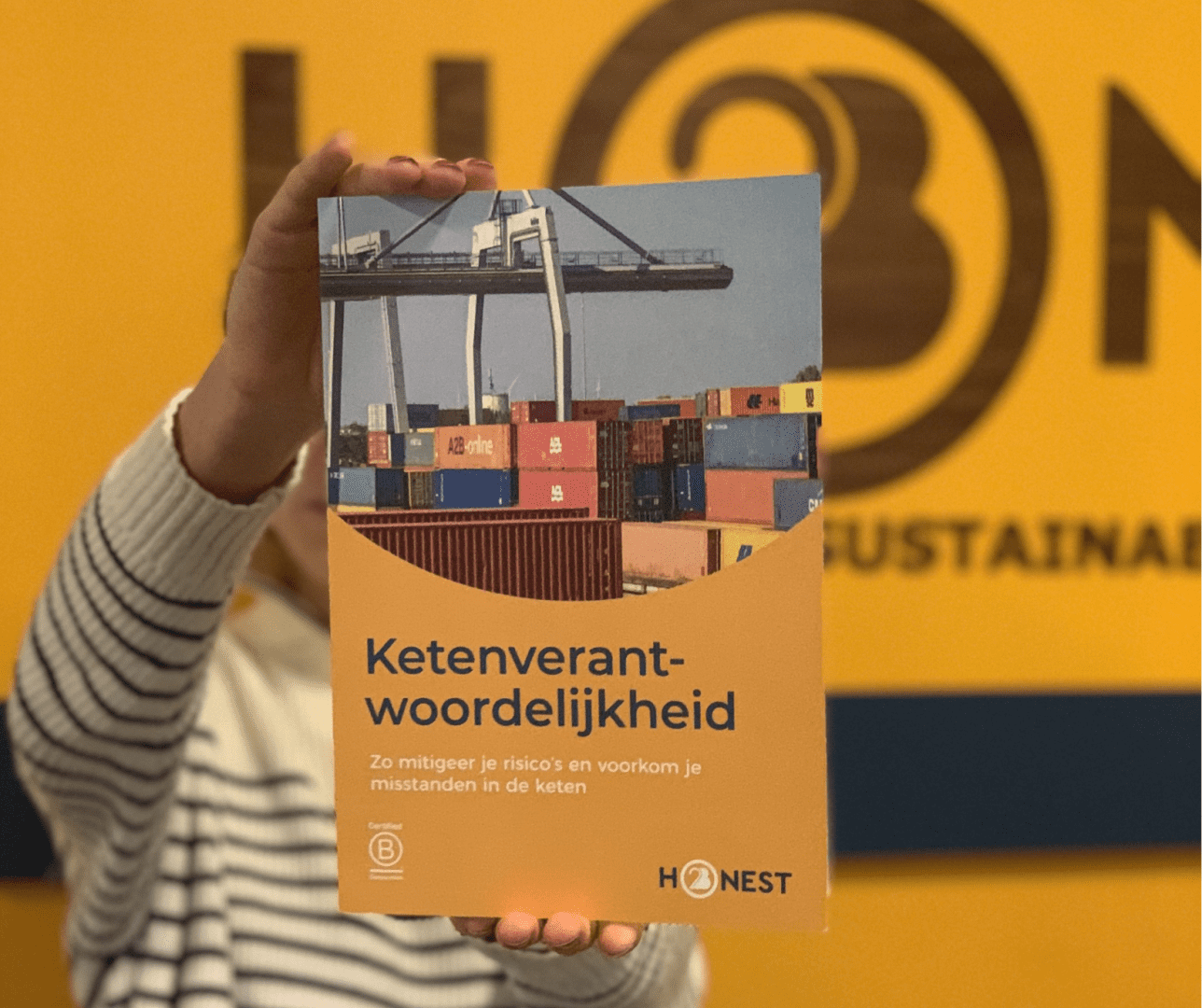
From there, we help you translate this into concrete actions, such as drafting a due diligence statement and incorporating this information into your CSRD reporting. We also train your procurement staff so they ask the right questions and understand the urgency of supply chain responsibility.
By bringing strategy and execution together, we help companies make sustainable and responsible choices throughout their supply chain. And they have no choice but to do so. Companies can no longer claim ignorance. The “anti-look-the-other-way law” requires companies to take action as soon as risks become apparent. Supply chain responsibility is no longer optional — it is simply a“license to operate.”
Want to learn more about due diligence, ready to get started in the boardroom, or need help with implementation? Lydia is here to help!
Lydia Boonstra