



Pieter van ’t Hoff
Managing Director
Collecting and using ESG data requires clear decisions and a well-defined division of roles. Many companies start with Excel, but when does that stop being enough? And who takes which steps in setting up a robust ESG data system — from strategy to implementation? Pieter van ‘t Hoff explains how we support companies by providing a strong substantive foundation, while leaving the technical implementation to specialists in that field. “It’s all about everyone doing what they’re good at — that’s the only way to achieve a result that works,” says Pieter.

ESG data forms the backbone of corporate social responsibility. On the one hand, there are ambitions and strategies — the stories you want to tell; the qualitative aspect. On the other hand, there are the hard numbers that show whether you’re on track — the quantitative aspect. Without data, strategy remains a promise, and without strategy, data lacks direction. Both are indispensable, whether it concerns CO₂ emissions, diversity, or ethical issues. Optimizing your ESG data collection gives you greater insight and enables you to steer toward your goals.
Exactly. ESG data goes far beyond reporting requirements; it’s a powerful management tool. Goals like cutting your CO₂ emissions in half sound great, but without data, you have no way of knowing whether you’re making progress or need to adjust course. In addition, ESG data allows you to identify correlations, such as the impact of CO₂ reduction on costs or revenue. That makes it indispensable, but at the same time complex.
For us, data processing isn’t just about a single annual report, but about continuous insights that help us make adjustments. ESG data must not only be accurate and consistent — as required by legislation such as the CSRD — but also usable at every level, from strategic to operational. This requires robust data collection and a well-designed data system to truly help your organization move forward.
An ESG data system stands or falls on the reliability of its data: it must be accurate, complete, and traceable. Many companies start with Excel, which is not surprising. It’s easy to use, flexible, and comes pre-installed on every laptop. Anyone can work with it, and you can use it to build complex spreadsheets.
However, that accessibility also has a downside. Precisely because everyone uses it, errors can occur — often unintentionally. Even a single incorrect formula or entry can have consequences. And when multiple colleagues add data, it becomes nearly impossible to figure out where things went wrong. You can’t see who changed what or where a number came from. This makes Excel prone to errors and less suitable as data requirements increase.
As ESG data requirements become stricter, more people are working with it, and data collection becomes more complex, Excel is reaching its limits. A professional data system offers the solution: it automates data collection, clearly allocates responsibilities across departments, and makes it easier to identify gaps. In addition, you can collect and report data tailored to your needs: operational figures monthly, strategic KPIs quarterly or annually, and immediate notifications in the event of incidents. This ensures consistency, transparency, and control over your ESG goals.
At some point, our customers ask us: Which software is best for us? Or: Which tools or systems should we choose? Our answer is always the same: We don’t know.
That’s right; we deliberately do not provide advice on software. That is not our area of expertise, nor is it our role. Our expertise lies in laying the substantive foundation for sustainability: what do you want to measure, why is that important, and how can you translate that into concrete data? We leave the technical work — such as building and implementing software — to specialists: software developers and implementation experts. And to be honest? We don’t know which party is best at that either. What we do, once a system has been selected, is work with those specialists to ensure that the content is accurate and the system aligns with the goals.
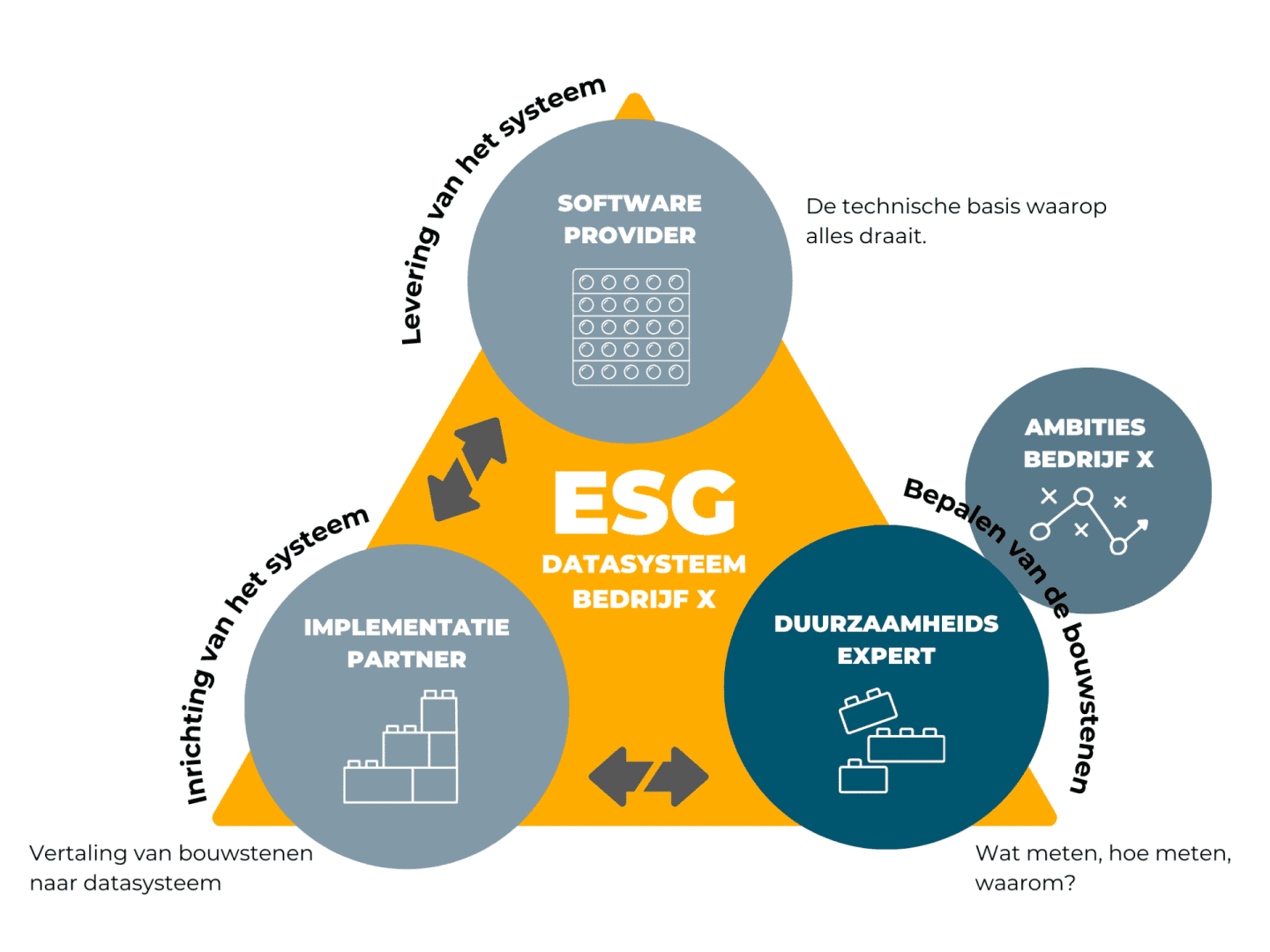
Exactly. As you can see in the image below, each party has its own role. The software vendor provides the system on which everything runs. This could be a major player, such as Microsoft, or a niche provider specializing in ESG software. They provide the technical foundation and often offer support to the implementation partner or handle the implementation themselves.
The implementation partner configures the system based on the building blocks we define together with the client. They ensure that the software is tailored to the company’s specific needs. They make sure everything is correct and that the system is airtight.
And what about us? We’re the sustainability experts, so we define those building blocks for the system — such as CO₂ emissions per revenue or diversity in FTEs. These building blocks determine not only what you measure, but also how you measure it. It starts with clear definitions: what exactly do we mean by FTE? How do you determine CO₂ emissions — in kilograms, metric tons, or another standard? And when it comes to diversity: do you look at the male-female ratio, age groups, or other variables? These kinds of choices are crucial because they shape the insights you can ultimately derive from your data system.
Deployment is just the beginning. After that, the testing phase begins, during which we use the system for the first time with real data. That always yields lessons learned. Think of minor errors in calculations, missing data, or unexpected challenges, such as privacy regulations in certain countries.
We implement improvements in collaboration with our implementation partner. We typically repeat this process two to three times until the system is robust enough to be used in practice. Even after that, we often remain involved. We help clients not only interpret the data correctly but also use it effectively to steer their ESG goals.
Make sure you have the right foundation in place. Before you start thinking about software or systems, you need to be clear about what data you need and what you want to achieve with it. Without that foundation, you run the risk of wasting time and resources on systems that don’t work for your organization.
Work with specialists. The strength of a good ESG data system lies in the collaboration between subject matter experts, implementation partners, and software vendors. Each party has its own role, and when everyone does what they do best, you end up with a system that really works.
But what’s most important? View ESG data as an opportunity to look ahead and improve your business. A good data system is more than just a tool; it’s a way to turn strategic goals into concrete action.
Want to learn more about smart data collection and setting up a robust ESG data system? Pieter is here to help!
Pieter van ’t Hoff