


Maarten Andriessen
Senior Consultant
In this article, Maarten Andriessen his insights on CO₂ compensation, also known as“carbon offsetting.” This is a method whereby a company offsets its CO₂ emissions by investing in projects that reduce or absorb carbon dioxide emissions. It sounds great on paper — but in practice, there are many snags, making it a controversial topic. Maarten explains why and offers better solutions.

Then I say: Reduce emissions first, and view offsetting as a last resort.
CO₂ offsetting means that companies try to neutralize their CO₂ emissions by investing in projects that reduce or absorb carbon dioxide. Examples include planting trees, solar and wind energy projects, or energy-efficient technologies such as electric stoves in developing countries. Companies purchase so-called credits that correspond to a specific amount of offset CO₂ emissions. The goal is to “reduce” their own emissions, reach net-zero, or even become “climate-positive” by offsetting more than they emit.
With carbon offsetting, the term “climate-neutral” can become a matter of accounting “pluses and minuses” rather than actual emissions reductions. With a little creativity, companies can label themselves as “zero” without seriously addressing their own emissions. The system essentially allows companies to simply buy their way out of their pollution. And unfortunately, this happens far too often. There are companies that pay millions to offset their emissions. This gives them a false green image — though fortunately, we’re increasingly seeing through it — without contributing to solutions for the climate crisis. The money that companies spend on offsetting could be invested much more effectively in improving processes to reduce their own ecological footprint.
Certainly, there are many concerns about the effectiveness of CO₂ offsetting. A major point of criticism is the lack of transparency and guarantees regarding the actual impact of offset projects. It is often difficult to verify whether the promised CO₂ reductions are actually being achieved, especially since intermediaries frequently collaborate with small, local organizations. In addition, there is a lack of strict regulation regarding certification, which leads to differences in interpretation. There are many different entities offering offsets, each with their own certifications, which makes market dynamics and the trading of credits even more complex and less transparent. There is also considerable doubt regarding the sustainability of these offsets. For example, whether the planted trees will actually survive in a changing climate, and whether forests that are being protected were already protected or were even slated for logging in the first place.
Given these significant doubts and uncertainties, we recommend exercising extreme caution with this approach. Consider it a last resort — a “last resort.”
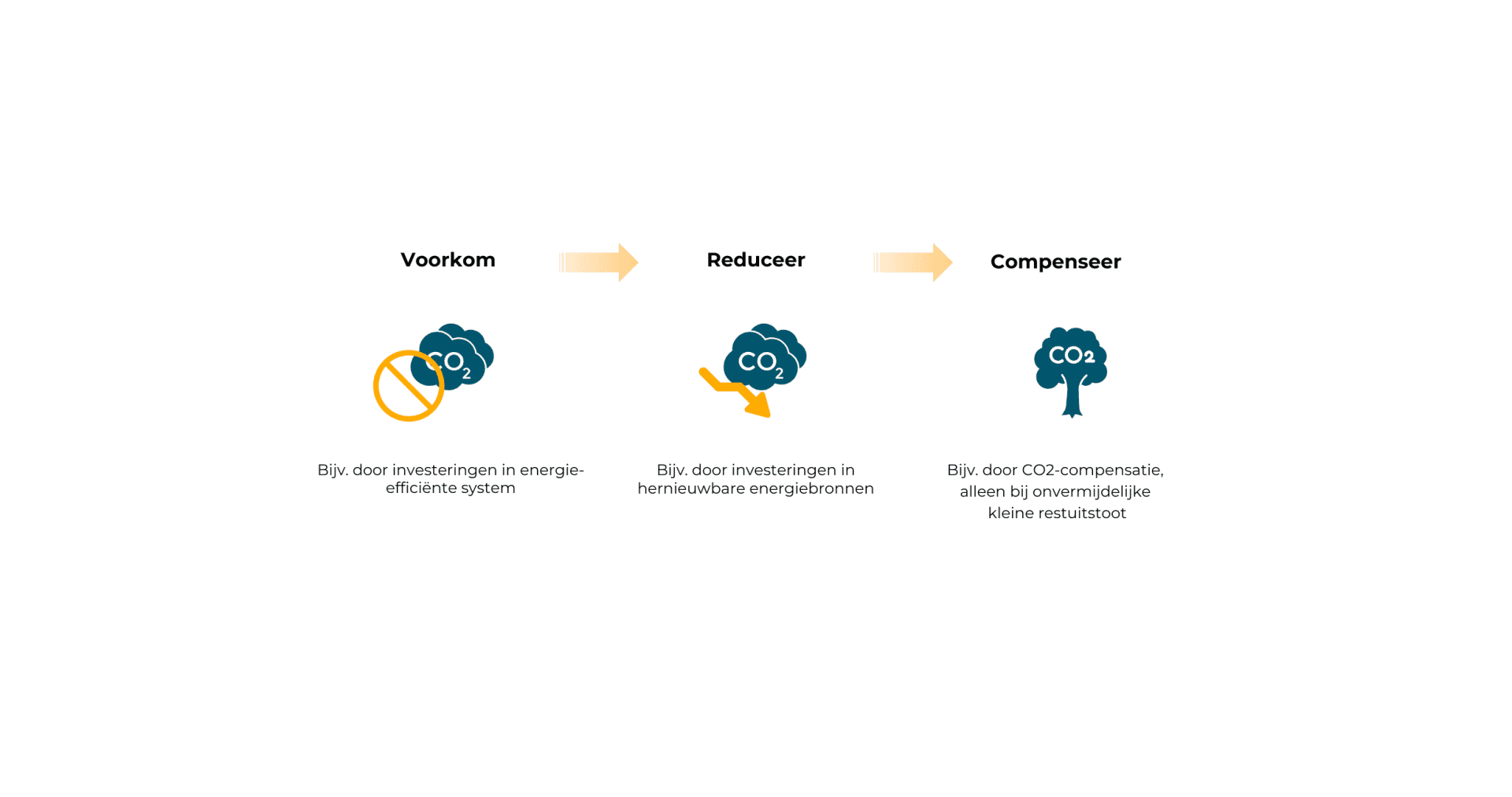
By “last resort,” we mean that companies should only consider offsetting after they have done everything in their power to reduce their own emissions — and we mean absolutely everything. Our approach consists of three steps.
Absolutely. You can only spend your money once. Why would you choose a buyout — a recurring system you’re locked into every year — when you could also invest in your own business? For us, that’s a no-brainer. By investing in energy-saving measures and innovative technologies, you can reduce your carbon footprint while also lowering your operating costs. Thinking long-term is essential here. Companies will see that offsetting emissions will become increasingly expensive over time, while investing in sustainable solutions actually saves money. This isn’t just better for the environment; it also strengthens your company’s reputation and long-term vision. So use your resources to take concrete steps and reduce emissions yourself. Choose to tackle the problem rather than offset it. That benefits the world far more — and ultimately, your company as well.
The Paris Climate Agreement requires companies to achieve net-zero emissions by 2050. At first glance, offsetting may seem like a sufficient solution to achieve this goal, but the introduction of the CSRD makes it clear that “creative accounting” is no longer acceptable. After all, the CSRD requires companies to transparently report their CO₂ emissions, reduction measures, and any offsets, thereby diminishing the value of offsetting as a primary strategy for low CO₂ emissions. In addition, there is the Science Based Targets Initiative (SBTi) — which we wrote about earlier — that encourages companies to reduce 90% of their emissions by 2050 and offset only 10%. This underscores the importance of actual emissions reductions over offsetting, which helps companies comply with future regulations and contributes to a sustainable economy.
First, make sure you’ve really done everything possible to reduce your emissions. Are you complying with all guidelines, and is that last 5 to 10% unavoidable? If so, you can opt for offsetting — to address those final percentages. Look for an established and reliable offset partner with high-quality offset projects that your company can trust. Be aware that there is never a complete guarantee that these projects will achieve the full promised CO₂ reduction. However, if you’re certain that you’ve done everything possible to minimize your own emissions, you can communicate this to your stakeholders and customers in a responsible manner.
For us, it’s still a clear-cut case: do you have extra budget? Always invest in prevention and reduction. Believe me: there’s always a way to make an even bigger impact with the resources you have available.
Companies should focus on actively preventing and reducing their CO₂ emissions, rather than opting for CO₂ offsets. This is not only better for the environment, but also strengthens companies’ reputations and long-term vision. Offsetting emissions should only be considered once all other options have been exhausted.
Want to learn more about preventing, reducing, and offsetting emissions? Maarten is here to help!
Maarten Andriessen